
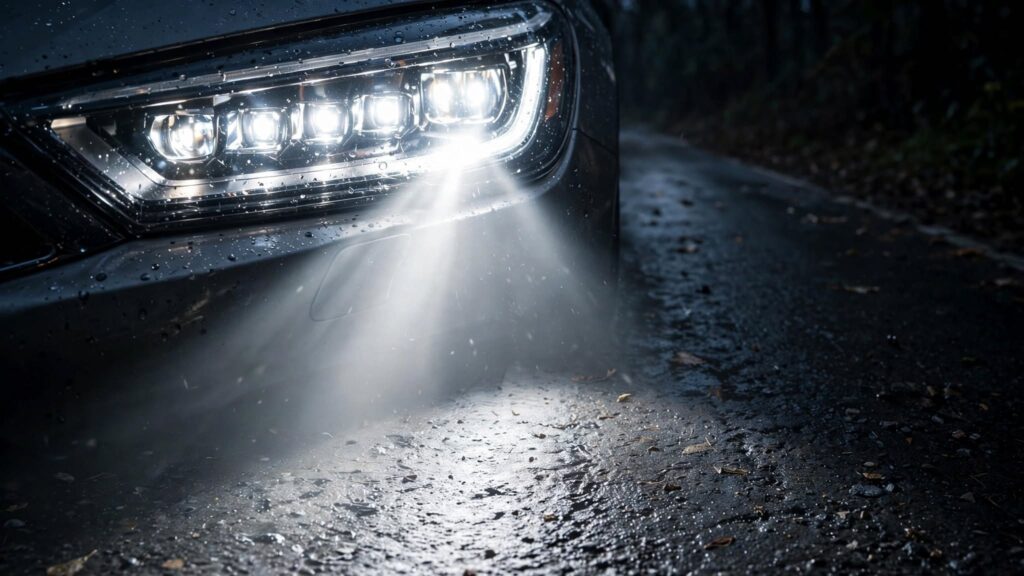
Vehicle lighting affects much more than how a car looks after dark. Headlights, fog lights, brake lights, turn signals, and interior lamps all help drivers see clearly and communicate with other road users. As lighting technology has developed, LED bulbs have become a common option for many automotive applications.
LED bulbs can improve vehicle lighting performance through more efficient light production, quicker response, longer service life, and flexible beam characteristics. However, good performance depends on choosing bulbs that suit the vehicle’s housing, electrical system, and intended use.
How LED Bulbs Work in Vehicle Lighting
LED stands for light-emitting diode. Instead of producing light by heating a filament, as a traditional halogen bulb does, an LED uses a semiconductor to produce light when electrical current passes through it.
This difference affects both energy use and lighting behavior. LEDs can produce useful illumination while drawing relatively little electrical power, and they reach full brightness almost immediately.
Automotive LED bulbs are used in several areas, including headlights, daytime running lights, fog lights, brake lights, turn signals, reverse lights, license plate lights, and cabin lighting. The design requirements vary depending on where the bulb is installed.
Improved Visibility and Light Quality
One reason drivers consider LED bulbs is their ability to provide clear, focused illumination when paired with a compatible lighting assembly.
Clearer Road Illumination
LED vehicle lighting often produces a crisp light that can make lane markings, signs, road edges, and nearby obstacles easier to distinguish at night. For headlights, however, brightness alone does not determine performance.
The position of the LED chips inside the bulb matters because the headlight reflector or projector was designed around a particular light source. If an LED replacement places the light in the wrong position, the beam may scatter instead of being directed properly onto the road.
A correctly matched LED bulb and housing can provide a more controlled beam pattern while limiting unnecessary glare.
Consistent Light Output
Traditional filament bulbs can gradually change as they age. LEDs operate differently and can provide consistent illumination over much of their usable life when their electronics and thermal management are properly designed.
This consistency can be useful for exterior vehicle lights where predictable visibility is important.
Faster Response for Signal and Brake Lights
LED technology also performs well in applications that switch on and off frequently. LEDs illuminate almost instantly when electrical current is applied.
For brake lights and turn signals, this quick response creates a sharp, immediate visual signal. It also gives lighting designers greater flexibility when creating compact tail lamps and signaling systems.
Drivers replacing conventional signal bulbs should still check vehicle compatibility. Some vehicles monitor bulb resistance and may display warning messages or cause rapid turn-signal flashing when an incompatible LED bulb is installed.
Lower Electrical Demand
Energy efficiency is another practical advantage of automotive LED bulbs. Because LEDs produce light differently from filament-based bulbs, they generally require less electrical power for comparable lighting applications.
Reducing the load from individual bulbs may seem minor, but modern vehicles contain many lighting points. Headlights, cabin lights, parking lamps, cargo lights, and other systems all draw power from the vehicle’s electrical network.
Lower power consumption is particularly useful when lights remain on for extended periods, such as interior, utility, recreational, or auxiliary lighting.
Heat Management Still Matters
LED bulbs are efficient, but that does not mean they operate without heat. Heat builds around the LED chips and electronic components and needs to be moved away effectively.
Automotive LED bulbs may use aluminum heat sinks, cooling fans, or other thermal-management designs. If heat cannot escape, lighting performance and component life may suffer.
Installation space therefore matters. A large heat sink or fan assembly may not fit properly inside a compact headlight housing. Dust covers, wiring, and surrounding components should not be forced into place simply to accommodate an oversized bulb.
Environmental protection matters as well, particularly for lights exposed to rain, spray, dust, or moisture. Similar considerations are discussed in What to Look for When Buying Waterproof Marine LED Lighting, where sealing and exposure to demanding conditions are important parts of selecting suitable lighting.
LED Bulbs Can Reduce Routine Replacement
Vehicle bulbs operate in an environment that includes vibration, temperature changes, and repeated switching. Since LEDs do not rely on a delicate glowing filament, they can be well suited to many automotive lighting applications.
A longer usable service life can mean fewer bulb replacements, especially in locations that are difficult to access. Actual lifespan still depends on bulb construction, operating temperature, electrical conditions, and installation quality.
A poorly designed LED bulb with inadequate cooling may fail earlier than expected, so LED technology by itself does not guarantee durability.
Choosing LED Bulbs for Better Vehicle Lighting Performance
Upgrading vehicle lighting should involve more than choosing the brightest bulb available. Compatibility and beam control are just as important.
Before installing LED bulbs, consider:
- Bulb size and socket type
- Headlight reflector or projector compatibility
- Available space for heat sinks or cooling fans
- Vehicle electrical and bulb-monitoring systems
- Intended use, such as headlights, fog lights, signals, or interior lighting
- Beam pattern and glare control
- Local requirements governing exterior vehicle lighting
For headlights in particular, check the beam after installation. A bulb that appears bright when viewed from outside the vehicle may still distribute light poorly on the road. Proper alignment and a defined beam pattern are essential for useful nighttime visibility.
Limitations of LED Vehicle Lighting
LED conversion is not automatically an improvement for every vehicle. Some older headlight housings were designed specifically around halogen filaments, and an LED replacement may not reproduce the intended optical pattern.
Electrical compatibility can also create problems. Dashboard bulb warnings, flickering, or turn-signal hyperflashing may occur when the vehicle detects a different electrical load.
Physical fit is another consideration. Bulbs with external drivers, fans, or large heat sinks can require more room than the original lamp assembly provides.
These issues make it important to evaluate the complete lighting system rather than judging a bulb solely by its stated brightness or appearance.
Conclusion
LED bulbs can improve vehicle lighting performance by providing clear illumination, quick response, lower electrical demand, and practical durability. Their advantages apply across headlights, signal lamps, brake lights, interior lighting, and other automotive applications.
The quality of the result, however, depends heavily on compatibility. Correct bulb placement, beam pattern, thermal management, electrical operation, and physical fit all influence real-world performance. Choosing an LED bulb that works properly with the vehicle’s existing lighting system is more important than simply selecting the brightest option.